

Sing, Muse
A beginning, about beginnings.

“μῆνιν ἄειδε θεὰ” - Homer’s Iliad Book 1, Line 1.
From the rambling descriptions of Tolkien’s The Hobbit to the baffling yet beautiful narration of Shinkai’s Your Name, I have a number of personal favorite “beginnings”. Given this is the beginning of this newsletter, I thought I would take the chance to discuss possibly the most consequential of all, Homeric epic.
μῆνιν… ἄνδρα… Quite how to communicate the significance of these two words is a question for its own essay, but here I shall do my utmost. μῆνιν, or menis can be approximately translated to (divine) “wrath” or “anger”, and is the opening word of the Iliad. It sets the stage for this poem, and is specifically referencing the wrath of Achilles, the driving force of the epic. ἄνδρα is conversley the opening word of the Odyssey, which means “man”, in this case referring to Odysseus. This is significant due to Odysseus’ central role on the Odyssey, but also the broader commentary on the nature of “man”/humanity, present in the Odyssey. This clearly shows the programmatic function of the opening words of these epics, and how they embody the essence of the work they begin.
This however, is not to me the most significant aspect of the opening of a homeric epic - this comes with the muse invocation. The reason I value this aspect of the epic is because it conveys signposts the form and structural commentary of the poems, or the aesthetics of Homer, in the same way these other words signpost thematic elements. The muse invocation in Homer is always within the first line of the epic, and involves the narrator in some way asking for the muse to sing/tell of the opening word, be that Achilles’ menis or Odysseus the man. Here Homer actively draws attention to both the form and authority of the poem.
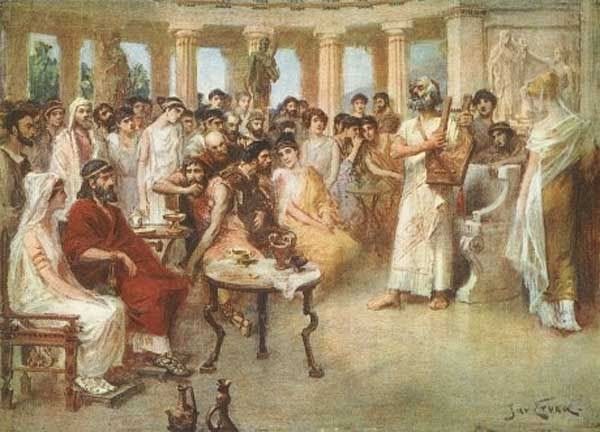
The term used in the Iliad is “ἄειδε” - Sing, this is exactly how Homer’s contemporary audience would experience his work, through song. The Odyssey uses the verb ἔννεπε, which is less inherently musical, but still evokes tale telling, what Homer was essentially doing. This self-conscious meta-poetics is continued throughout both the Iliad and Odyssey with depictions of song which have immense aesthetic, philosophical and literary value, and could be studied for years on end. It is also significant that this is the invocation of divinity, the muse or Goddess. The narrator is given a sense of authority, what they are telling comes from the Gods, and therefore has truth and validity, this again is elaborated on later in the epics, to great effect.
What I am trying to demonstrate here, is how the opening line of the Epics alone are able to foreground so many vital aspects of the poems, and look towards the future of the epic. They explore the themes, plot and form of the epic using a mere three words. However, why does this really matter. What further can we take from this - after all what’s the point of ideas abandoned in the abstract?
I see this opening as particularly significant because it foregrounds the artistic and performative nature of the Homeric epics. I think this should lead us to take seriously the future aesthetic commentary found within these works, which seem remarkably sophisticated. The same is true for the thematic commentary of Homer, though I feel this has gotten more attention in modern scholarship.
This also shows the epic considering the power of voice, authority and knowledge, and their relationship. The communicative power of Homer is embodied by his impassioned plea to the muse - “sing”, “recall”. Perhaps voice alone isn’t enough, the narrator could sing, yet he requires the authority and knowledge of the Goddess. Yet again, the muses require the poet to communicate to the audience the knowledge of the Goddess - they are stuck in this symbiotic relationship, they need each other. The same is true for us today. Ideas, knowledge, power - these are all well and good - but without communication, they mean nothing. A politician could have brilliant ideas and make positive change, but without communicating that to the voting body, they would never get elected, for example. What these opening lines from Homer represent, therefore, is not simply the literary function they serve, but a deep reflective representation of the role of the bard, and his own limitations.
Thank you for reading! This is fairly all over the place, and is just really a way for me to get started writing about some things which interest me, and give a slight taste of what I may go on to write.
Thanks again if anyone reads this, and if you are interested, then feel free to subscribe!