

Capturing experience with Sappho & Monet
A lesson from two of the world's most wondrous artists.

(Introduction - Nick Drake)
What does it take to capture a moment? A dash of colour, fragrant flowers, water droplets dripping down a damp hillside. These are all minute details, small and insignificant, but this sensory experience can be a powerful way of transporting you into that moment. Sapho, the Ancient Greek poet, and Monet, the French Impressionist painter - they knew how to capture a moment.
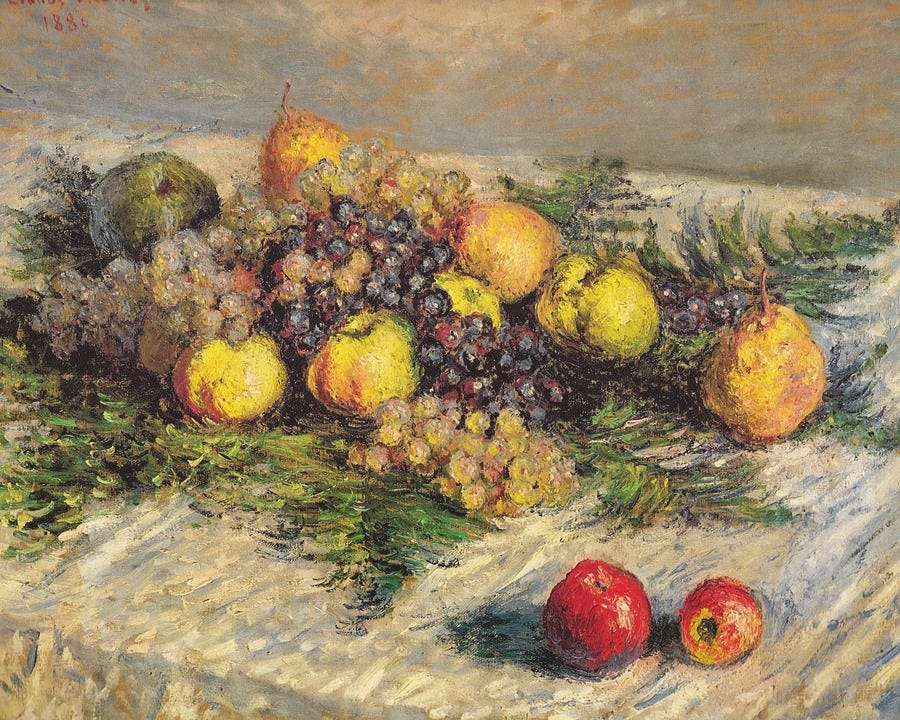
Pears and Grapes is perhaps an odd painting to begin with, depicting such a static scene. This however is precisely why I think it so important. Monet here is breathing life and vibrancy into fruit on a table, what should be mundane and simplistic. The fruit invites extacy, and implores pleasure, you can almost imagine the decadent Dionysos inhabiting every stroke of the brush. What this painting does is give you such a strong sense of the scene, exaggerating and bringing out the colour and shape of its subject in a way which pulls you in and immerses you thoroughly.
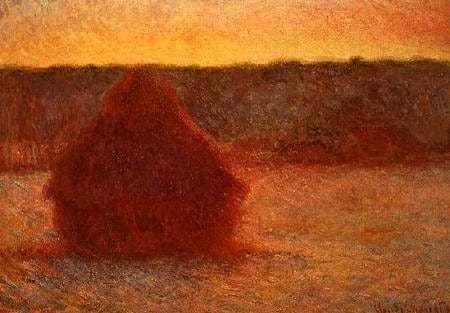
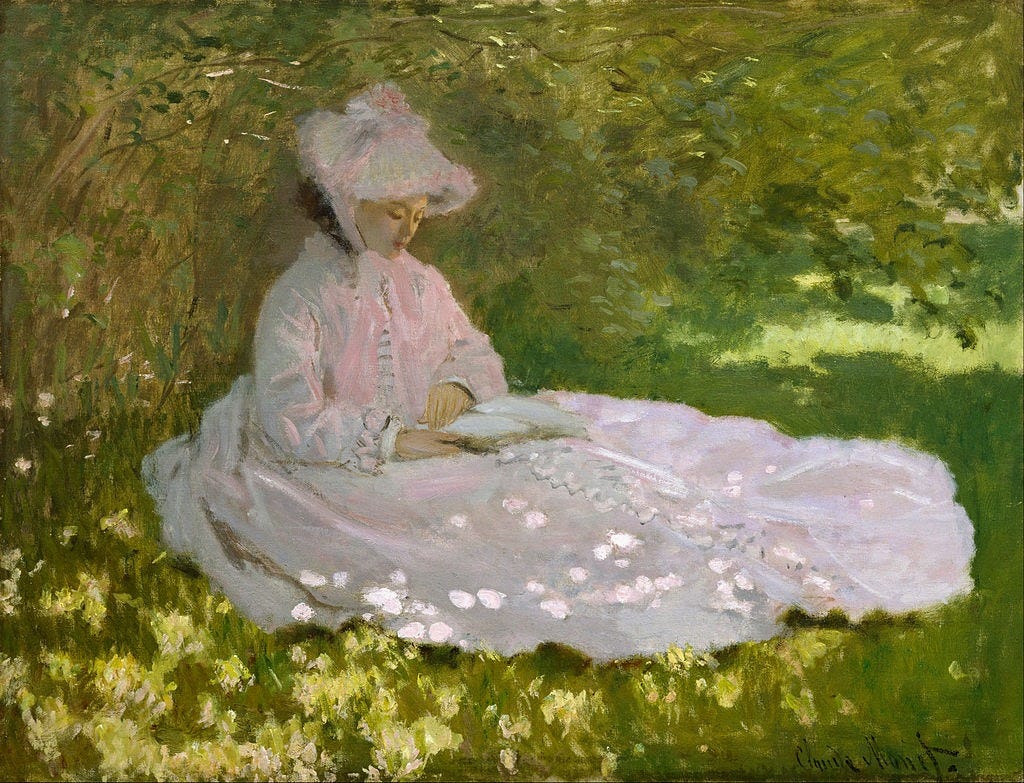
However, this pure static scene is fairly rare in Monet, and often change or temporality is generated in his paintings, be that through the subject, his environment, or his own artistic decisions. One example is, Haystacks at Sunset, Frosty Weather. This captures the sun just under the horizon, giving you a window into a fleeting moment, with this change contrasted with the still, peaceful haystack. Similarly, in A Woman reading you have a perfectly pensive figure with light practically dancing along her dress, while she stays peacefully still. This again feels like the depiction fleeting moment, contrasting still with change.
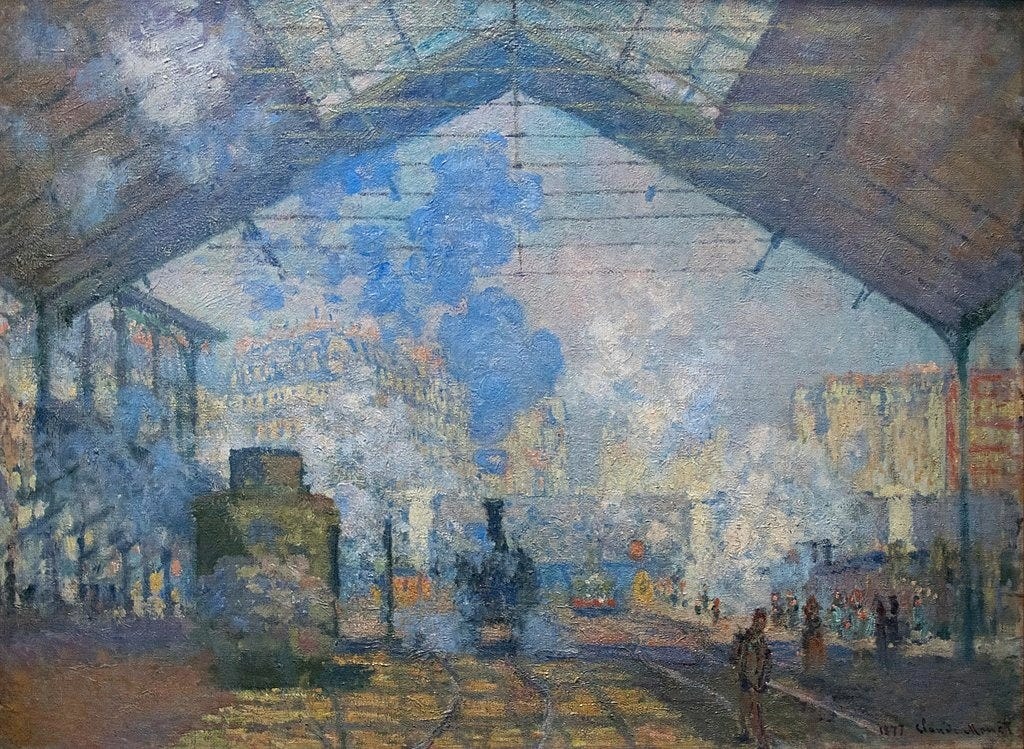
But Monet’s ability to capture a fleeting moment is - in my view - best on show with his The Gare Saint-Lazare, a painting of trains coming in and out of the Saint-Lazare Train Station in North-east france. He was stuck by how the light interacted with the smoke from the trains, and attempted to capture it. Here the sense of one’s experience is so perfectly transmitted into art. This is certainly no realist photographic painting of what exactly he saw, but the sense of his experience is given to us.
However this is not all. Monet was enraptured by the effect of the smoke, and through this transported his own imagination onto canvas. We are not only getting an idea of the scene, but the way it interacted with the eye, mind and soul of the interpreter.
So, what Monet was able to do, was to transmit the sensory and imaginative experience into painting. He used exaggerated colour, contrast and brush strokes to give us not just a vibrant sensory experience, but to transport us to the moment in which he was painting. This captures the sense of a scene in a way unlike anything achievable in realism or photographic recreations. The experience becomes something you are immersed in. Time is frozen, and you are allowed to bathe in the ecstasy of that precious moment.
(Miroirs III. Une barque sur l’ocean - Maurice Ravel)
Now, let us turn to Sapho. Ancient Lyric poetry is largely defined by the presence of a “voice” and an addressee. This is vital to Sappho’s poetry, and serves to focus the audience’s attention and invite them into the moment. “I beg you”, “(you) Come to me now”, “You be my ally”. These all occur in Sappho’s Fragment 1, a hymn to Aphrodite. Although this speech is directed explicitly from Sappho to Aphrodite, these direct addresses still have relevance to the audience. We are implicitly called to attention, and told to engage directly with the poem at hand, as well as being more thoroughly immersed in the conversation being depicted, due to our subtle involvement.
Deathless Aphrodite of the spangled mind,
child of Zeus, who twists lures, I beg you
do not break with hard pains,
O lady, my heartbut come here if ever before
you caught my voice far off
and listening you left your father’s
golden house and came,Sappho, Fragment 1 (Lines 1-8) - Trans. Anne Carson
This is emphasised by the repeated use of “δηυτε” (dēute, translated by Carson as “now again”) throughout the poem, almost as though the audience is being implored to enact the poetry themselves. Now: the present moment, both for Sappho in her writing, but also the audience in their current experience of that work. Again: once more, we must repeat what has come before. The temporality is stretching from the present, into the past and future.
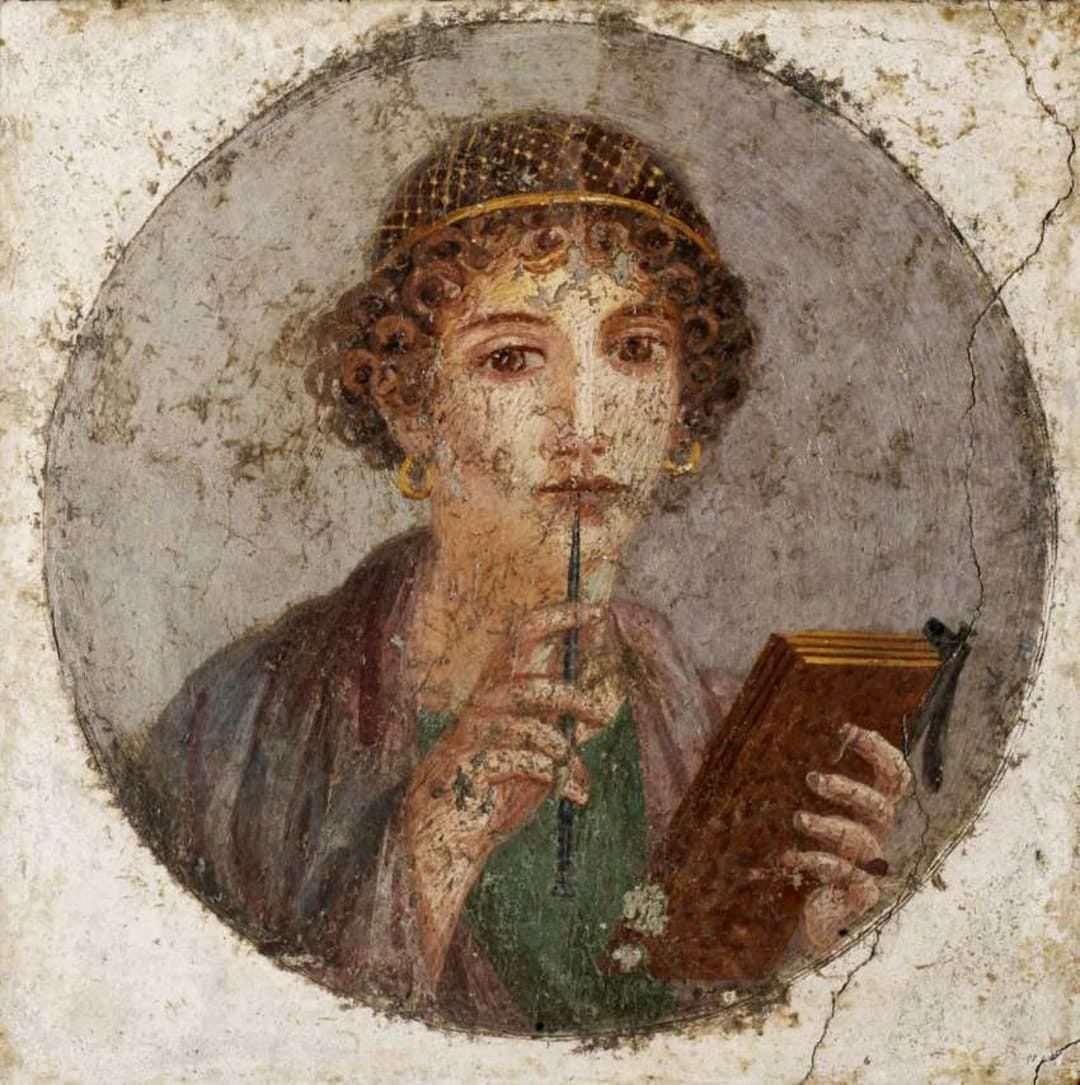
In Sappho Fragment 22, we also see her ability to capture a moment, in a more self-reflective, meta-poetic manner. The use of δηυτε is once again present, but now it refers specifically to the performance of song. The adverb calls us to attention, emphasising this moment, and the repetition of it, but that just begs the question: what are we paying attention to?
I bid you sing
of Gongyla, Abanthis, taking up
your lyre as (now again) longing
floats around you,Sappho, Fragment 22 (Lines 9-12) - Trans. Anne Carson
Sappho is capturing the moment of her own creation, her own process of poetic composition and performance. This is not any poetry she is depicting, it is love poetry - her primary genre. We get a true window into her psyche with the idea of her being enraptured with longing as she sings and composes. Furthermore, we again get this direct address: “longing floats around you”. Just as she is depicting herself as being intoxicated by desire, we too are brought into this intimate moment. This, just as was the case with Monet, is a window into the mind and imagination of Sappho as she creates her own work.
So, clearly both Monet and Sappho are able to achieve similar effects, despite their contrasting times and mediums. They both draw attention to time, Monet bringing static figures to life with his paintings acting as a time capsule, expressing beautifully the exact moment of its creation. Sappho, draws the audience to the sense of time and its ability to stretch from the present moment both forwards and backwards, but ultimately one is drawn to the now, she addresses you.
But even more than this, they both work to give an insight into their own personal view of the world, and the way their own experiences occur. Their art enacts the process of experience in a powerfully subjective manner. The subjectivity here isn’t something to be ashamed of, they’re not attempting to depict an objective reality, instead it is embraced. The subjective experience is powerfully transported into art, and the result is the audience being immersed in the scene in a way impossible with an attempt at realism.
So, what does it take to capture a moment? To me, it takes opening yourself up to your own experiences, and translating those as best you can. It takes allowing the subjective nature of our daily lives to seep into how you view the world and create your work. And, of course, it takes an immense amount of talent and skill - clearly had by these two artists - something we can all aspire to.
I really enjoyed reading this!